Top Signs You Need Garage Door Service – Don’t Ignore These
A garage door that takes three seconds longer to open than it did last year isn’t aging gracefully. It’s telling you the spring tension has dropped enough that the opener motor is compensating, and that motor wasn’t designed to do that indefinitely. The tricky part is that garage doors fail slowly, so every warning sign gets rationalized as “normal for an old door.” If you’ve noticed any of the nine symptoms below, the door is asking for help. If you’d rather not climb a ladder to investigate, call (866) 857-0883 and we’ll take a look.
What are the most common signs you need garage door repair?
Here’s the short answer: the most common signs are a door that moves slower than it used to, a bottom gap you can see daylight through, grinding or squealing sounds, shuddering during travel, and an opener that reverses on its own. What matters more than the symptom is the cause behind it. Each sign maps to a specific failing component, and knowing which one helps you decide whether it’s a quick adjustment or something that needs parts. Around Cuyahoga Falls, our freeze-thaw swings between winter and spring work metal and seals harder than most homeowners expect, so these symptoms often show up faster here than on the same door in a milder climate.
Here are the nine observable signs worth watching for:
- Slower travel time. Spring tension loss. The opener is doing work it wasn’t built for.
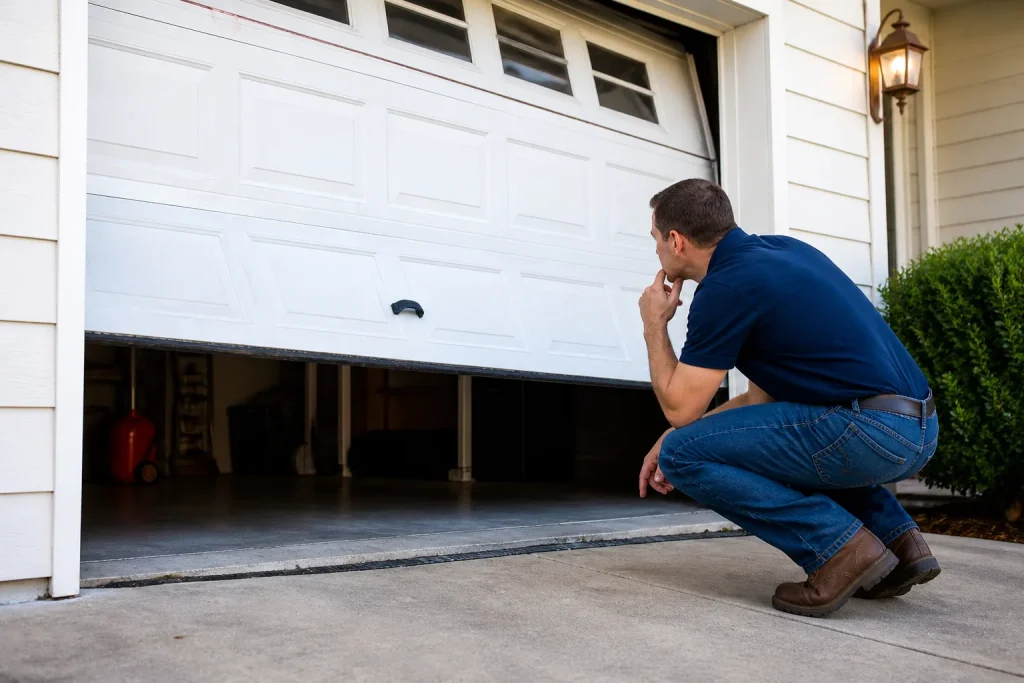
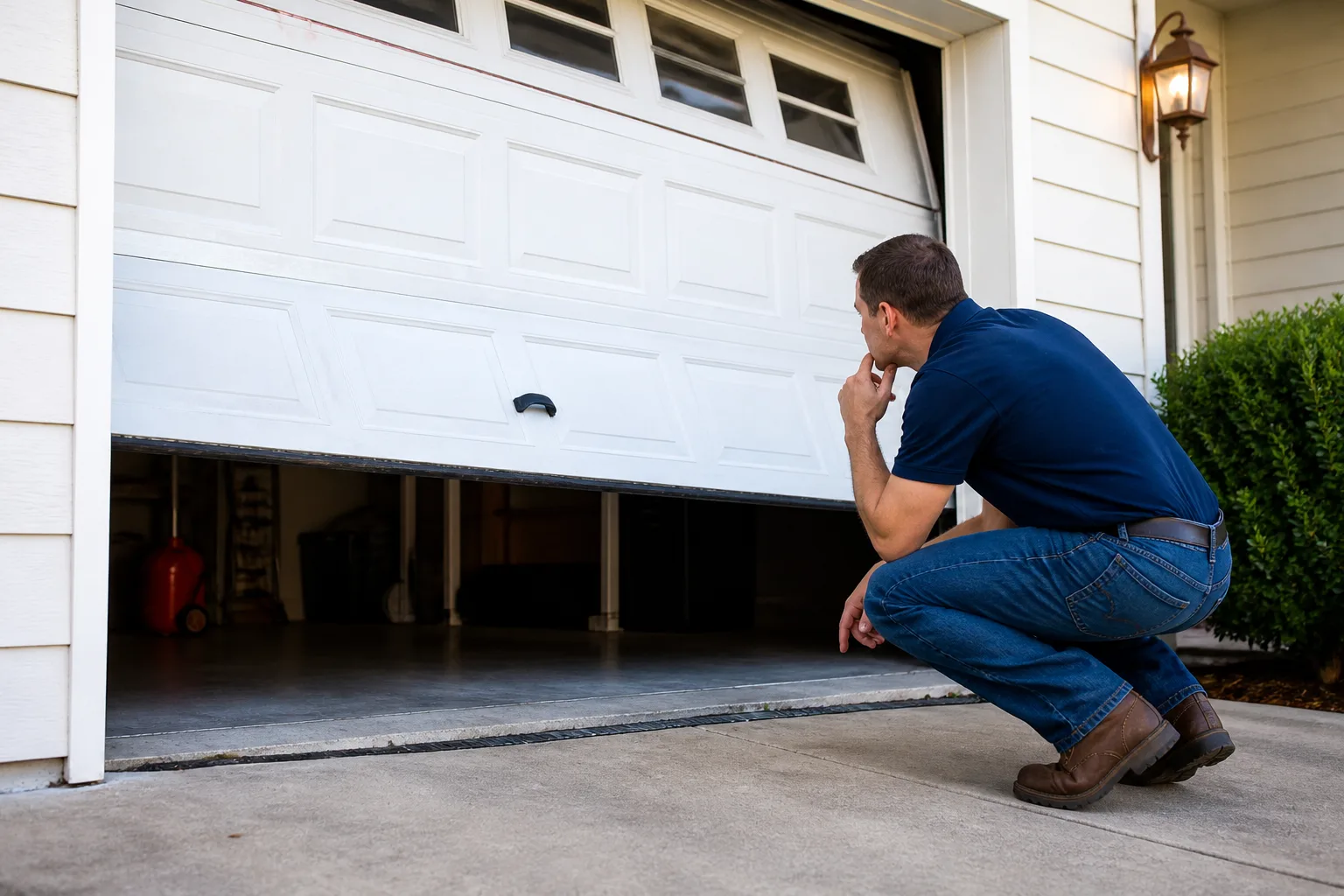
- Visible gap at the bottom seal. Worn weatherstripping, a bent track, or a loose hinge.
- Grinding on the way down only. Usually a roller or track problem.
- Grinding on the way up only. Usually a tension, cable, or drum issue.
- Shuddering mid-travel. Roller wear, track misalignment, or uneven spring balance.
- The door drifts or sags when opened halfway. Spring balance is off (more on this below).
- Opener sounds different than it used to. Gear, bearing, or chain wear.
- Opener runs longer than it should. It’s fighting tension loss or a binding track.
- Opener reverses or stops on its own. Safety sensor, limit switch, or logic board fault.
If more than two of these fit your door, you’re past the “watch it” stage.
The overnight sag test: a 90-second spring check
Spring wear is invisible from the outside, but balance isn’t. Here’s a test any homeowner can run without touching a spring or a cable:
- Close the door, then pull the manual release cord so the opener disengages.
- Lift the door with your hands to about halfway open. It should feel light and stay roughly where you leave it.
- Let go. A well-balanced door stays put or drifts down slowly.
A door that slams down, drifts quickly, or feels heavy enough that you have to strain tells you the springs are no longer carrying their share of the weight. That’s the point where we usually hear the “it’s always been heavy” line, but a door that used to open with two fingers and now needs two hands is a door that’s been quietly losing tension for months. The overnight part is simple: the next morning, before anyone drives, check whether the door sits flush again after you’ve re-engaged the opener. A door that hangs or drops within a few inches of travel overnight means there isn’t much spring left.
Don’t test springs by hand or try to adjust them. They’re under heavy tension and can cause serious injury if they let go. Spring replacement is the one job on this list where calling a pro isn’t optional caution – it’s the safe path. If your test points to spring wear, that’s the moment to get someone out rather than the moment to get curious.
Why intermittent problems are more urgent than steady ones
Counterintuitive, but true: a door that’s consistently slow is usually less dangerous than a door that works 19 out of 20 times. Consistent symptoms come from steady wear – the door is telling the truth every time. Intermittent symptoms come from borderline components: a limit switch that occasionally loses contact, a sensor that only fails when the sun hits it at a certain angle, a spring that’s hanging just past its rated cycles. Those components are one cycle away from failing completely, and the failure happens without warning. In our experience around Cuyahoga Falls, the “it only does it sometimes” call almost always turns into a part replacement, while the “it’s been slow for months” call is often a cleaner diagnosis. So if your door occasionally refuses to close, occasionally reverses, or occasionally doesn’t fully open, treat it as a higher priority than a door that’s just running rough.
What your opener is telling you (and what it isn’t)
The opener is the door’s narrator, and its behavior changes by symptom. It’s worth separating them:
- Sounds different. Usually a stripped gear, a worn bearing, or a chain that’s lost tension. LiftMaster and Chamberlain units with chain drives are the most common offenders we see, and Genie screw drives can develop a distinct whine as the shuttle wears.
- Runs longer than it should. The opener is doing more work than it needs to, which usually traces back to a binding door, a worn roller, or a spring that’s no longer assisting. Fixing the opener without fixing the door is throwing parts at the symptom.
- Reverses on its own. Most often the safety sensors, sometimes a limit switch, occasionally a logic board. If the door reverses only when the sun is in the sensor’s face, that’s a sensor alignment problem, not a door problem.
If you’re hearing an opener that’s clearly struggling, our garage door opener repair service covers the major brands including LiftMaster, Chamberlain, Genie, and Craftsman, so you won’t hear “we don’t work on that.”
How one worn part turns into three
Here’s the pattern we see most often in Cuyahoga Falls: a homeowner puts off a $120 repair because the door “still works.” Three weeks later, the same worn roller has flat-spotted the track, the hinge above it has fatigued, and the cable has started to fray from the extra friction. What was a simple roller-and-hinge fix becomes a track-and-cable job. The numbers here aren’t dramatic, but they’re real: the compounding cost of ignoring one warning sign is almost always higher than fixing it when you first noticed it. A garage door is a system, and each component is sized for the one next to it. When one gets sloppy, the ones beside it take the strain. The bottom seal is a good example – a small gap at the bottom doesn’t just leak Cuyahoga Falls cold air in winter, it lets water sit at the base of the door, which rusts hinges and accelerates track wear. Fixing the seal early is cheap. Replacing the hinges and the track isn’t.
When to call a pro
Some adjustments are genuinely DIY-friendly: tightening a loose hinge bolt, wiping a track clean, replacing a sensor that won’t align. Others aren’t safe to touch, and the line is worth knowing clearly. Call a trained technician if you’re seeing:
- Spring sag or a door that won’t hold position mid-travel
- A cable that’s frayed, slack, or off its drum
- A door that slams shut rather than lowering under control
- Track that’s bent or knocked out of alignment
- Any commercial door or a door heavier than a standard single- or double-residential door
For those, garage door spring repair and garage door repair are what you need, and our technicians have up to 8 years of experience with doors from Clopay, Amarr, Wayne Dalton, and other major manufacturers. If the door fails outside of normal business hours, emergency service is available – call and we’ll get a visit scheduled.
Related services in Cuyahoga Falls: spring repair, opener repair, and full door replacement when a repair no longer makes sense.
The Bottom Line
The nine signs above aren’t a scare list – they’re a diagnostic list. A slow door, a bottom gap, a brand-new grind on the way down: each one has a specific mechanical cause, and knowing which one lets you stop saying “it’s always been that way.” The overnight sag test is the cheapest diagnostic you’ll ever run. If it points to spring wear, don’t wait. If you’re not sure, we’ll take a look and tell you honestly whether it’s a quick fix or something bigger.
If you’re in Cuyahoga Falls and need help, Cuyahoga Falls Garage Door Repair Pros offers free estimates – call (866) 857-0883. We work on the major brands including LiftMaster, Chamberlain, Genie, Clopay, Amarr, Wayne Dalton, Craftsman, and Raynor, so you’re not chasing down a second company when the diagnosis changes.
Frequently Asked Questions
How do I know if my garage door springs need replacing? The clearest sign is a door that won’t hold position when lifted halfway – if it slams down or feels heavy, the springs have lost tension. Visible sag, a door that opens much slower than it used to, and a loud bang from the garage are also signs. Spring replacement is safety-critical work, so call a trained technician rather than testing or adjusting them yourself.
Can I fix a noisy garage door myself? Some noise is DIY-friendly – a squeaky hinge can be tightened, a gritty track can be wiped down and lubricated. Grinding that happens only on the way down, or only on the way up, usually points to a worn roller, track, or cable that needs a proper diagnosis and replacement part. If the noise is paired with slow travel or shuddering, call us at (866) 857-0883 for an estimate – the springs may be involved, and that’s not a DIY job.
Is it normal for a garage door to get slower over time? No. A garage door opens at roughly the same speed for its whole life until something wears out. Slower travel means the opener is compensating for lost spring tension or a binding track. It’s the earliest and most reliable sign of wear, and it’s the one most homeowners ignore the longest. Catching it early usually means a smaller repair.
When is a garage door repair an emergency? It’s an emergency if the door is stuck open (leaving the home unsecured), stuck closed with a car trapped inside, hanging unevenly from one side, or has a cable that’s come off the drum. Those situations can cause injury or property damage if the door is operated. Call us at (866) 857-0883 and we’ll schedule a visit – emergency service is available.
If you’re in Cuyahoga Falls and need any of the repairs above, Cuyahoga Falls Garage Door Repair Pros is who to call – free estimates, upfront pricing, and the written quote is what you pay.
Written by the team at Cuyahoga Falls Garage Door Repair Pros.
Need Garage Door Help?
Call Cuyahoga Falls Garage Door Repair Pros - the local pro we connect you with is licensed and insured, here with fast after-hours help in Cuyahoga Falls.
(866) 857-0883